Explain the Difference Between the Voltage Output at the Battery
Significance of emf in DC machine. Voltage across each bulb adds up to the total voltage from the battery in a series circuit.

Pin On Electronic Circuit Diagrams
A simple analogy would be the size of the fuel tank in a car.
. We dont measure the actual watermetal voltages produced by each battery plate. The current stays essentially the same getting fractionally larger. One with smaller resistance has less voltage across it.
Voltage electric potential difference electric pressure or electric tension is the difference in electric potential between two points which is defined as the work needed per unit of charge to move a test charge between the two points. Once stable the following will provide a good reference for the battery state of charge. Current is expressed in Amps A.
In a series circuit explain the relationship between the current at the battery and each bulb in the circuit. Voltage is the normal parameters for a cell. The size of the cell is irrelevant to its voltage.
Along these lines power output drops directly. Battery Voltage The voltage V rating of a battery is a measurement of how much power that battery can provide. Power supply and the current through each component in the series circuit.
And thats where the output-voltage of a battery comes from. To obtain greater voltage than the output of a single cell multiple cells must be connected in series. Whenever the emf across the electrical machine is higher than the voltage across the load the current fed from the machine to load such a machine is called generator.
Construct the simple circuit displayed below using a 330 ohm resistor diode and a switch in the open position. The voltage across each bulb adds up to the total voltage from the battery. Ive drawn a picture of a simple circuit with two points near the positive terminal.
The voltage output at the battery is 9 and as it goes across more components it gets less and less. With a battery voltage of 12V up to 15V will correspond to 2 to 4 Wh with each battery. People say that the voltage across one resistor is equal to the voltage supplied.
Subsequently the power output is almost constant. Terminal Voltage V The voltage between the battery terminals with load applied. Voltage is denoted by v.
Turn the variable power supply on. This is referred to as the battery open circuit voltage. To put this in very simple terms the higher the voltage the more powerful the battery.
With the switch open Measure the voltage across the power supply across the 330 ohm resistor and across the diode. The open-circuit voltage depends on the battery state of charge increasing with state of charge. One with larger resistance has more voltage across it.
-- The individual voltages divide up according to the resistance of each device in the loop. Open-circuit voltage V The voltage between the battery terminals with no load applied. The total voltage of a battery is the sum of all cell voltages.
The voltage across each bulb in a series circuit will be the same across each bulb but the current flow will be affected based on any ohms that may be present. In the International System of Units the derived unit for voltage is named volt. 2 question Explain the difference between the voltage output at the battery and the voltage across each bulb in the series circuit.
Instead we only see the difference between the pair of watermetal voltages that had been created by the two metal surfaces inside the battery. 166 In SI units work per unit charge is expressed as joules per. Explain the difference between the voltage output at the battery and the voltage across each bulb in the series circuit.
A typical automotive lead-acid battery has six cells for a nominal voltage output of 6 x 20 or 120 volts. To eliminate these external factors turn off all loads and disconnect the solar array to allow the battery voltage to stabilize. Explain the difference between the voltage output at the battery and the voltage across each bulb in the series circuit.
Terminal voltage varies with SOC and dischargecharge current. It quantifies how many electrons are flowing per second. The current stays essentially the same getting fractionally larger.
To put it simply Ah is a measure of how much charge the battery can provide. Voltage EMF Voltage Drop. Explain the difference between the voltage output at the battery and the voltage across each bulb in the series circuit.
While electrons continuously flow along a given circuit opposition to their movement is referred to as resistance. -- The individual voltages across each device in the series loop all add up to the voltage of the battery. The volts are 4.
Apparently if we take the potential difference of these two points it will equal 9V according to the above saying which can be found all over google. The voltage of a battery is defined by the elements in the positive and negative side cathode and anode. A motivation or voltage causes the electrons to flow.
A capacitors voltage drops straight after some time at a constant current. Ie EMF is greater than the voltage. Explain the difference between the voltage output at the battery and the voltage across each bulb in the series circuit.
Up to 24 cash back A series circuit has only one path for current to flow while a parallel circuit has more than one path. Output Capacity mAh Efficiency x Battery capacity mAh x Battery voltage V Charging voltage V. An alkaline battery or NiMH cell in a standard AA size has something about 2000 to 3000 mAh.
Up to 24 cash back The voltage output at the battery is going to be 100 of whatever the batterys voltage is. In a series circuit the voltage increases as you pass each resistance force because it takes more effort to go through the resistors. You are to interpret the schematic diagram to create a circuit.
If you have a load running the battery voltage will drop and if there is a charging source the voltage will increase. - The voltage output at the battery is same with battery voltage. Voltage is defined by how much energy each electron has as it moves.
Output Capacity mAh x Charge Voltage V Efficiency x Battery Capacity mAh x Nominal Battery Voltage V Next we solve our variable which would be the actual capacity at the output port and finally we get the general formula. Their difference appears across the battery terminals. For example ZincManganese oxide in our alkaline batteries gives us a voltage of 15V.
Once you have chosen the energy you can specify the capacity by the amp-hour rating. A batterys voltage remains about constant as it discharges at a constant current. Voltage refers to the potential difference or amount of work to be done to move a charge from one point to another along an electric circuit.
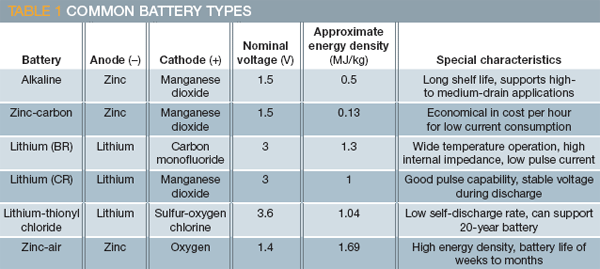
Battery Voltage Pveducation
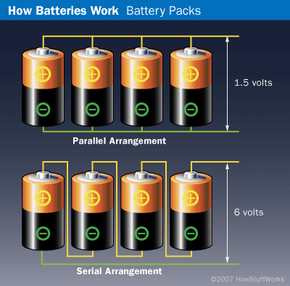
Battery Arrangement And Power Howstuffworks
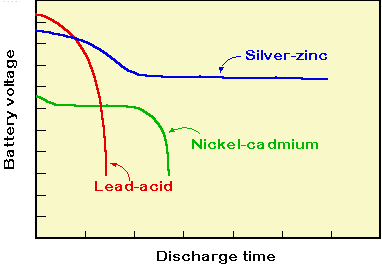
Battery Voltage Pveducation
No comments for "Explain the Difference Between the Voltage Output at the Battery"
Post a Comment